Tools · computed from the terrain
Mountain light: when the Rockies take the sun.
Official sunset assumes a flat horizon. West of Calgary the horizon is a mountain range. For 11 acreage regions we computed when direct sun really ends, on every day of the year.
Try it
Watch the sun meet the mountains.
Choose a region and a day, then drag through the last hour of the afternoon. The silhouette is the computed skyline; the sun's upper edge is followed minute by minute.
The interactive view could not load. The tables further down this page hold the same results for every region.
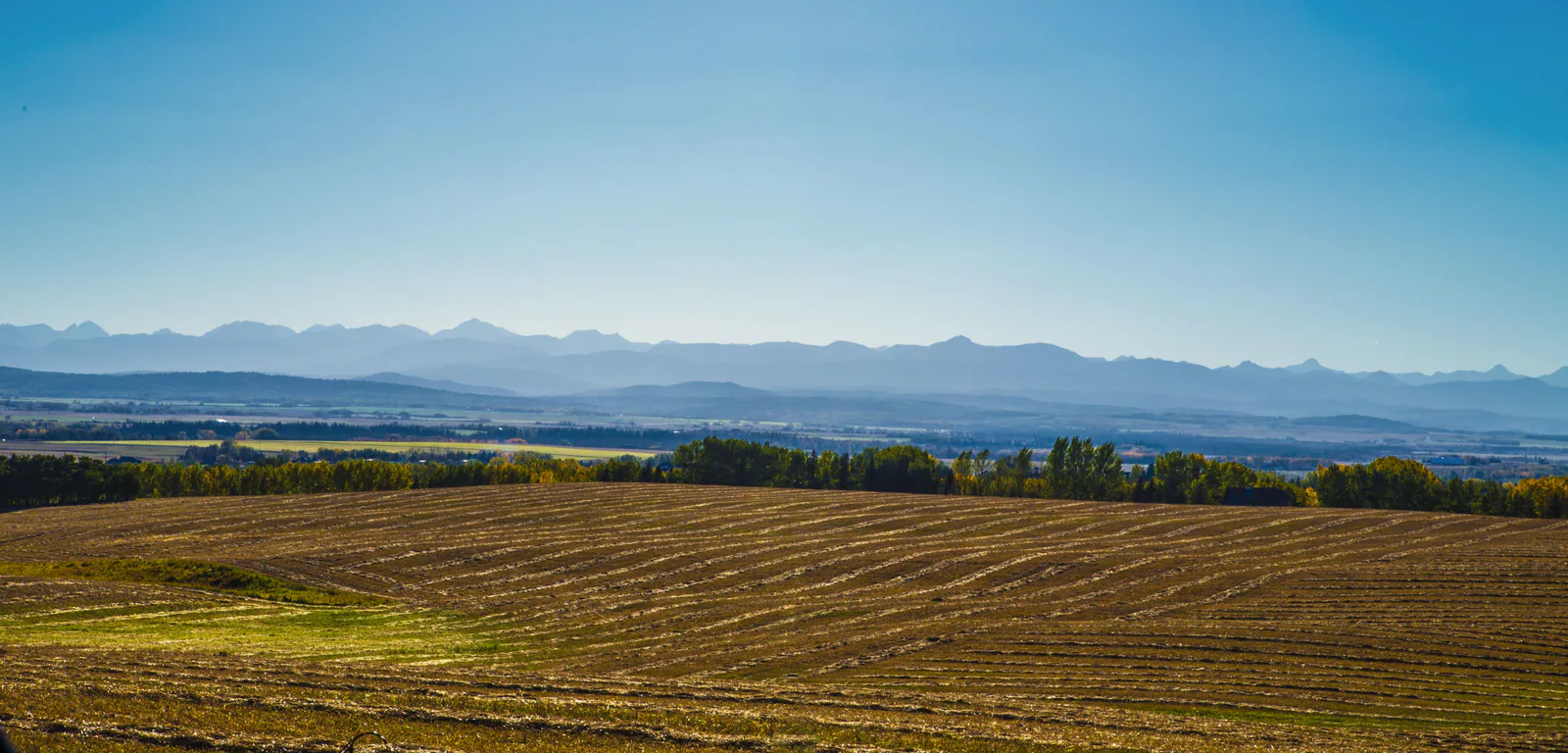
The time printed for sunset is when the sun meets a flat, level horizon. Standing on an acreage in the foothills, you face the Front Ranges, which stand a degree or three above that level line. The sun disappears behind them before the official sunset, and how much earlier depends on where you are.
- Winter solstice
- 7–17 min earlier
- Longest daily gap
- 19 min · Bragg Creek
- Regions · days each
- 11 · 365
Across the 11 regions, direct sun ends between about 7 and 17 minutes before the official sunset on the winter solstice, December 21. The pattern is not simply a winter one. In Bearspaw the summer solstice costs about 15 minutes, more than the winter solstice's 9, because the June sun sets farther north, where the skyline it faces (1.5° above level) is higher than in the south-west (0.9°).
Each region's page shows the skyline it faces and its own year of sun, and the numbers below come from the same computed terrain.
Every region compared
Winter solstice, December 21Summer solstice, June 21
| Region | Winter solstice: direct sun ends | Lost, Dec 21 | Lost, Jun 21 | Longest gap of the year | Typical day |
|---|---|---|---|---|---|
| Bragg Creek | 5:17 pm (official 5:34 pm) | 17 min | 9 min | 19 minMarch 11 | 14 min |
| Priddis | 5:18 pm (official 5:33 pm) | 16 min | 9 min | 16 minNovember 19 | 11 min |
| Diamond Valley & Turner Valley | 5:18 pm (official 5:34 pm) | 15 min | 6 min | 18 minJanuary 27 | 12 min |
| Millarville | 5:19 pm (official 5:34 pm) | 14 min | 7 min | 17 minJanuary 11 | 12 min |
| Elbow Valley | 5:21 pm (official 5:32 pm) | 12 min | 5 min | 15 minJanuary 19 | 9 min |
| Cochrane Area | 5:21 pm (official 5:32 pm) | 12 min | 4 min | 12 minDecember 17 | 8 min |
| Springbank | 5:21 pm (official 5:32 pm) | 11 min | 3 min | 13 minNovember 16 | 8 min |
| Okotoks & Foothills County | 5:22 pm (official 5:32 pm) | 11 min | 6 min | 12 minJanuary 18 | 8 min |
| De Winton | 5:22 pm (official 5:32 pm) | 10 min | 1 min | 12 minJanuary 18 | 8 min |
| Bearspaw | 5:22 pm (official 5:32 pm) | 9 min | 14 min | 15 minJune 14 | 9 min |
| East Rocky View | 5:24 pm (official 5:30 pm) | 7 min | 3 min | 8 minJanuary 1 | 4 min |
Reading it for land
- Low sun is weak sun. In the last minutes before sunset the light crosses far more air and arrives at a shallow angle, so it carries much less light and heat than at midday. These are minutes of low sun, but they are when a west-facing deck, window or driveway slope still catches the day's last direct light.
- Your lot is not the regional average. Each figure uses the highest bare ground near the region's centre. A site in a creek valley, at the foot of a west-side slope or behind a stand of spruce loses direct sun earlier; a site on a west-facing rise loses it later.
- See it at the hour that matters. A showing at noon in July says nothing about a December afternoon. If winter evenings on the deck are part of the picture, visit in the season and at the hour you care about.
- Solar panels or a large garden need a site-specific answer. This page does not estimate energy output or growing conditions. Ask a qualified installer or designer for a shade analysis of the exact spot.
- It is not a judgement of value or suitability. It is one measured fact about the land, set beside the others on the regional pages.
How it is computed
- The skyline. From each region's high-ground viewpoint, rays are cast every tenth of a degree from due south through west to due north, out to 150 km across the elevation model, allowing for the curve of the earth and standard refraction. The result is the highest apparent angle in every direction. The same data draws the skyline panorama on each region page.
- The sun. The sun's position uses the NOAA calculation from Jean Meeus's Astronomical Algorithms, accurate to about a hundredth of a degree. Its upper edge, with atmospheric refraction, is followed in ten-second steps through every afternoon of 2026.
- Two moments. Official sunset is when the sun's upper edge reaches a flat, level horizon. Direct sun ends is the last moment that edge is above the computed skyline in its direction. The difference is the minutes lost. On some days the sun slips behind a peak and reappears; the figure is the final loss.
- A check. The flat-horizon sunsets from this calculation match the U.S. Naval Observatory's Calgary instants to the minute when expressed in this model's Alberta clock rule: winter solstice (5:32 pm), spring equinox (7:50 pm), summer solstice (9:55 pm) and autumn equinox (7:34 pm).
What this does not include
Bare earth only: trees, buildings, haze and cloud are not modelled, and refraction changes with the weather. The viewpoint is the highest ground within 1.5 km of each region's mapped centre, a nominal point rather than a particular property, and sunrise is not modelled because the eastern horizon here is prairie. Other years differ by a minute or so. Check any specific property on site.
Clock times. Alberta will keep Alberta Time (ABT, UTC−6) through November 2026 and the winter, with no autumn clock reset. This 2026 model uses the former standard time (UTC−7) before March 8 and UTC−6 from that spring change onward. Clock labels do not change the calculated minutes of sun lost to the skyline.
Country living, considered
Light changes the feel of country living.
Plan for the transitions: changing access, weather and outdoor routines are part of owning the land through the year.
Seasonal ownership guide Open full image ↗
Private consultation
Want the afternoon light at a specific property?
Tell Dusko about your residential acreage or the country home you are looking for. Conversations are confidential and there is no obligation.
Dusko represents residential acreages and country homes. Abby Cline leads our rural program alongside Jenn Allen; both are licensed in residential and rural real estate with Real Estate Partners Team at Real Broker.