Strathmore, Carseland, Gleichen and the open farmland east of Calgary: larger parcels, wide skies and a different set of rules.
The Wheatland County property briefing
Big sky country. Read the parcel first.
Make the property review specific: the authority, the installed services, the owner responsibilities and the life you want to build here.
01
Which authority, which district
Towns, villages and hamlets sit inside the county’s boundaries, and the towns and villages govern themselves. Identify the exact authority for the legal parcel, then its district: Country Residential parcels run from 1.0 to under 5.0 acres, Agricultural General from 5.0 acres up.
Ask before committing
Which municipality and current district apply to this parcel, and what do they say about my intended use?
Request for the file
Legal parcel, written authority confirmation and the current land use bylaw sections with amendments.
Separate a private well, a hamlet or regional water line, irrigation-district water and any canal or creek on or beside the parcel. The bylaw sets a 100 ft setback from the top of bank of a river, creek or lake, set by a qualified professional, and the irrigation district treats its canals, driving banks and reservoirs as private property.
Ask before committing
What supplies household and yard water, and does an irrigation district, canal, creek or slope limit where I can build?
Request for the file
Well or service records, any irrigation-district account or agreement, and a qualified professional’s setback determination where needed.
Open farmland brings working neighbours and energy infrastructure. Confined feeding operations are regulated by the Natural Resources Conservation Board, which the County may only comment to, and the bylaw requires abandoned wells to be disclosed and set back under Alberta Energy Regulator rules.
Ask before committing
What operations, wells or pipelines are on or near this land, and which regulator handles each?
Request for the file
Registered instruments, Alberta Energy Regulator well and pipeline information for the parcel, and public information on any nearby feeding operation.
East of Calgary, Wheatland County covers 4,505 square kilometres of prairie farmland, from the Bow River country around Carseland to the hamlets of Gleichen and Rosebud. Its 2021 Census population was 8,738, and the county says its people are concentrated in Carseland, Gleichen, Speargrass and Lyalta.
Strathmore is a town inside the county's boundaries, not part of the County's own jurisdiction: the county says towns and villages within it are self-governed. A Strathmore address therefore does not tell you whose rules apply to a parcel. The legal parcel does.
Land use and parcels
Wheatland County's Land Use Bylaw 2016-01 (consolidated with amendments approved June 3, 2026) separates two main rural districts. Country Residential (CR) is for acreage development for predominantly residential purposes: parcels of 0.40 ha (1.0 ac) or more and less than 2.02 ha (5.0 ac), though larger sizes may be considered for land characteristics such as topography, water features or existing development. Agricultural General (AG) is for parcels of 2.02 ha (5.0 ac) or more, or the area in title when the bylaw was passed.
In both districts, buildings, structures and hard surfaces may cover up to 40% of the lot, and buildings must sit at least 22.86 m (75 ft) from a public road right-of-way and 3.05 m (10 ft) from other property lines; Alberta Transportation sets setbacks from highways and service roads. An accessory dwelling outside a hamlet may be no larger than 80% of the primary dwelling and needs its own address, an extra parking space, adequate water and sewer and a building permit.
What to check in Wheatland County
Which authority governs the parcel (County, town, village or hamlet) and its current land use district and amendments
Setbacks from water: the bylaw requires at least 30.48 m (100 ft) from the top of bank of a river, creek or lake, set by a qualified professional, and more from slopes of 15% or steeper
Irrigation: the Western Irrigation District, based in Strathmore, says the land, canals, driving banks and reservoirs that are part of its infrastructure are private property. Ask whether the parcel has water rights, a canal right-of-way, a crossing agreement or district charges
Abandoned and active oil and gas wells and pipelines: setbacks follow Alberta Energy Regulator requirements, and applicants must disclose abandoned wells on the land
Confined feeding operations: the Natural Resources Conservation Board, not the County, has full authority over them, though the County may comment on proposals
Water and sewage: private well and septic records, or the provider and agreement where a hamlet or regional system serves the home
Property tax
Wheatland County's 2026 residential rate totals about 5.17 mills: general municipal 2.5221, education 2.6044 and housing 0.0476 in Property Tax Rate Bylaw 2026-04. That total is a sum of the bylaw's rates, not a figure the county prints. The county reports a 3.55% increase in its own residential tax for 2026, while the education requisition set by the province rose 13%. Compare counties.
Pricing in Wheatland County
Alberta has no public register of sale prices, and acreage-only statistics are not published, so this guide does not quote acreage prices. For recent comparable residential acreage sales, ask Dusko directly.
From interest to evidence
Your Wheatland County viewing file
Keep the address, your essential plans and the questions that remain open in one place. Use these stages as a starting point for your own property review.
01
Before the viewing
Begin with the legal parcel and the decisions essential to your purchase.
Which municipality and current district apply to this parcel, and what do they say about my intended use?
Request: Legal parcel, written authority confirmation and the current land use bylaw sections with amendments.
Write down your essential residential plans and the evidence still missing.
02
At the property
Use the visit to identify questions for the right professionals.
What supplies household and yard water, and does an irrigation district, canal, creek or slope limit where I can build?
Record the approach, installed services and improvements with the owner’s permission.
Ask who can supply: Well or service records, any irrigation-district account or agreement, and a qualified professional’s setback determination where needed.
03
Before a contractual decision
Review findings against the actual agreement with your agent, lawyer and qualified specialists.
What operations, wells or pipelines are on or near this land, and which regulator handles each?
Obtain: Registered instruments, Alberta Energy Regulator well and pipeline information for the parcel, and public information on any nearby feeding operation.
Keep unconfirmed uses, incomplete records and unpriced work visible; this guide sets no condition dates.
A field sheet to take with you.
Download the questions, blank notes, local references and seller checklist. No account or email required.
A working checklist, not a clearance. These questions and the downloadable sheet do not establish zoning, suitability, safety, insurance or approval to build or occupy. Information can be incomplete, inaccurate or out of date. Confirm the property and proposal independently before relying on them.
For residential acreage owners
Present the setting. Prepare the evidence.
A strong Wheatland County listing helps buyers understand the home and the practical responsibilities that come with its land. Start with the records you can support.
Prepare the Wheatland County owner file with the actual municipality, current records and dates. Do not infer a permission from an area name.
Document the service and owner-responsibility questions: What supplies household and yard water, and does an irrigation district, canal, creek or slope limit where I can build?
Ask the listing team how to present the land and improvements accurately; unresolved questions about neighbours and what lies underground belong in the file.
Use the private working tools to organise your own assumptions and records. The possibility planner can be inaccurate or incomplete; it is not a zoning determination or approval.
Strathmore is a town within Wheatland County's boundaries. The county says towns and villages inside it are self-governed, and lists the Town of Strathmore and the Villages of Hussar, Rockyford and Standard among them. Rural parcels around them fall under the County's Land Use Bylaw.
The county's community profile names Ardenode, Carseland, Chancellor, Cheadle, Cluny, Dalum, Gleichen, Lyalta, Namaka, Nightingale, Redland, Rosebud and Speargrass, and identifies Carseland, Gleichen and Rosebud as hamlets. It says the population is concentrated in Carseland, Gleichen, Speargrass and Lyalta, and that future growth will cluster there, based on water treatment, wastewater and land-use planning capacity.
What size are country residential parcels in Wheatland County?
Under Land Use Bylaw 2016-01, a Country Residential (CR) parcel is 0.40 ha (1.0 ac) or more and less than 2.02 ha (5.0 ac), with larger sizes considered where land characteristics such as topography, water features or existing development justify it. Agricultural General (AG) parcels are 2.02 ha (5.0 ac) or more, or the area in title when the bylaw was passed.
What is the property tax rate in Wheatland County?
About 5.17 mills for 2026 residential property: the general municipal rate of 2.5221 plus education (2.6044) and housing (0.0476) in Property Tax Rate Bylaw 2026-04. That total is a sum of the bylaw's rates, not a figure the county prints. The county reports a 3.55% rise in its own residential tax for 2026, while the provincial education requisition for residential and farmland rose 13%.
How close to a river or creek can I build in Wheatland County?
The Land Use Bylaw requires a setback of at least 30.48 m (100 ft) from the top of bank of a river, creek or lake, with the top of bank determined by a qualified professional licensed in Alberta. Development next to a slope of 15% or more must be set back at least 30.48 m from the toe and top of the slope, or the distance a geotechnical report sets, whichever is greater.
Who regulates feedlots near an acreage in Wheatland County?
The Natural Resources Conservation Board has full authority over confined feeding operations and manure storage facilities under the Agricultural Operation Practices Act. Wheatland County's Land Use Bylaw says the County may comment to the Board on proposed new or expanded operations, in line with its Municipal Development Plan.
Can I add a second dwelling to an acreage in Wheatland County?
The Land Use Bylaw has rules for an accessory dwelling: outside a hamlet it may be no larger than 80% of the primary dwelling, needs its own address, one extra parking space, adequate water and sewer and a building permit, and cannot be on a property that already has a secondary suite. Confirm the district, the use and the approvals with the County before planning one.
Does a Strathmore address mean Wheatland County’s rules apply?
Not necessarily. Strathmore is a town inside the county’s boundaries and governs itself, while rural parcels around it fall under the County’s Land Use Bylaw. Identify the legal parcel and its authority first.
Can an online planner approve a project in Wheatland County?
No. Supplied measurements, district notes and conceptual drawings may be inaccurate or incomplete. Confirm the actual parcel, current requirements and proposal with the relevant authority and qualified professionals.
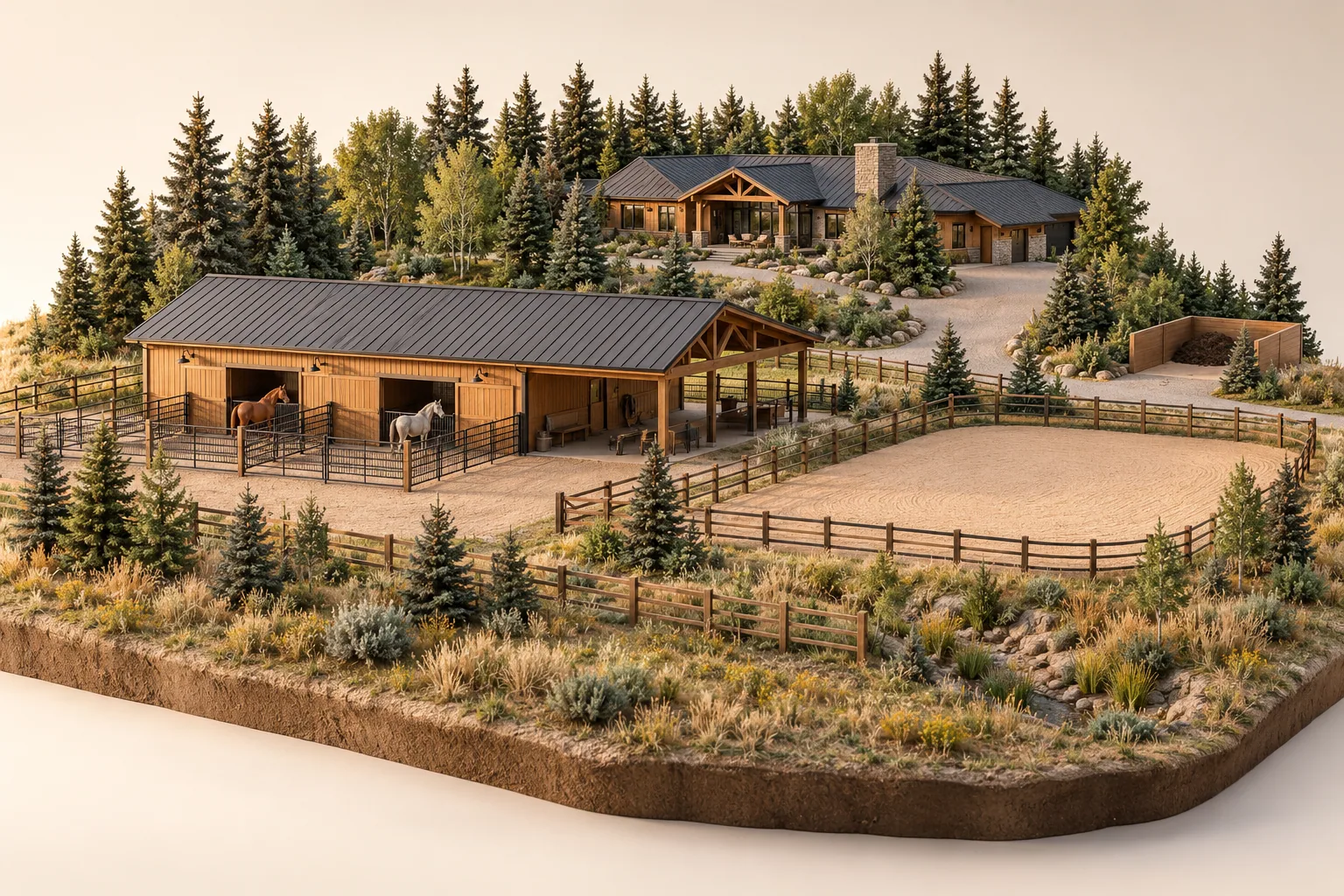
Think through turnout, access, shelter, daily care and the relationship to the home. Horse facilities and permitted uses need property-specific review.
Open full image ↗A country life with horsesThink through turnout, access, shelter, daily care and the relationship to the home. Horse facilities and permitted uses need property-specific review.Concept illustration · not a property survey, approved layout or listing photograph.
Private consultation
Buying or selling in Wheatland County?
Tell Dusko about your residential acreage or the country home you are looking for. Conversations are confidential and there is no obligation.
Dusko represents residential acreages and country homes. Abby Cline leads our rural program alongside Jenn Allen; both are licensed in residential and rural real estate with Real Estate Partners Team at Real Broker.